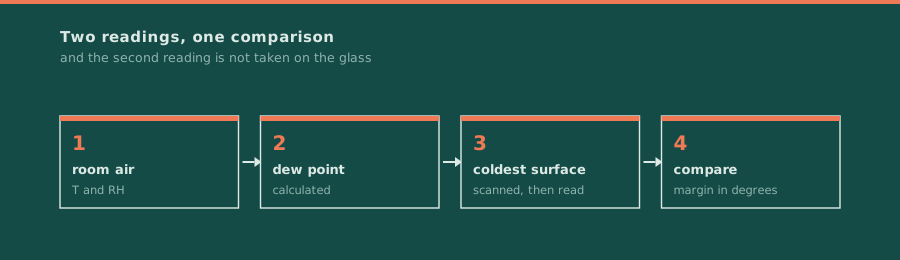
Condensation forms on whichever surface is coldest when that surface falls below the dew point of the air next to it. Deciding whether a window will condense therefore takes two readings, not one: the surface temperature and the room's dew point.
How to tell whether a window will condense inside
rev Cissue 04rev Crots yes — the figures above move with the standarddrawn by The Transom Set (a named set, not a person)
Two readings, one answer
The surface temperature is read with a contact or infrared thermometer at the coldest point, which is almost never the centre of the glass. On a modern unit the coldest point is the edge of glass or the frame, and it moves when the spacer or the break changes. The dew point comes from a hygrometer or from temperature and relative humidity together.
- Read the room air temperature and relative humidity, and convert them to a dew point.
- Find the coldest surface by scanning the glass edge, the frame, the break line and the corner.
- Read that surface temperature, and record where it was taken.
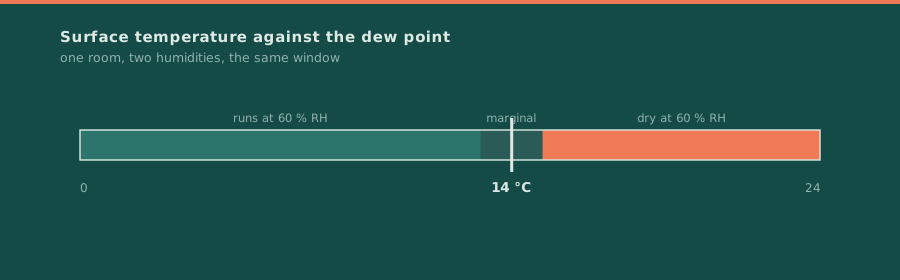
- Compare the two figures. A margin of two degrees or less is a window that will run on a colder night.
Why the coldest point moved
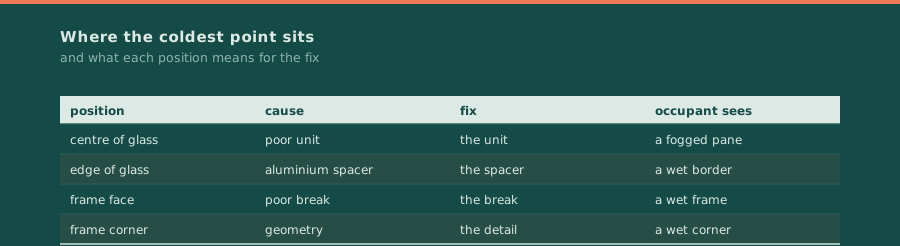
Improving the glass edge moves the coldest point onto the frame. That is a real and common outcome, and it is not a failure of the window: it is the consequence of making one part of a detail better than the part next to it. The occupant still sees condensation, in a place they did not expect, and the report comes in as a defect.
| Coldest point | When it is here | What to change |
|---|---|---|
| centre of glass | single glazing, poor unit | the unit itself |
| edge of glass | aluminium spacer | the spacer |
| frame face | broken frame, poor break | the break or the frame |
| frame corner | geometry, thermal bridge | the detail, not the product |
A condensation index is not a dew point, and a dew point is not a humidity reading. Three different quantities, three different instruments, and a report that gives only one of them has not established anything.
Where this sheet stops
This page covers the two readings and their comparison. The unit is owned by the unit page, the spacer by the spacer page, the frame break by the break page, and the rating system by the revision on frame condensation.
Documents this sheet is drawn from
- 1ANSI/NFRC 500-2023: Procedure for Determining Fenestration Product Condensation Index Ratingssupports the condensation index rating procedure used as the comparison method
- 2NFRC Technical Bulletin 2025-01: NFRC Condensation Resistance and Condensation Index Ratings for Products using VIGsupports the current rating publication and what it covers
- 3NFRC Program Bulletin 2025-12: LEAFF and Condensation Index Implementation Details and Deadlinessupports the implementation details and deadlines for the current rating programme
Each line points at one specific document, with its own title as the link text. No line is a home page and no line is a search result.
Sign the sheet and stop Sign the sheet and stop once you have both readings and the location of the coldest point. One reading on its own proves nothing.